

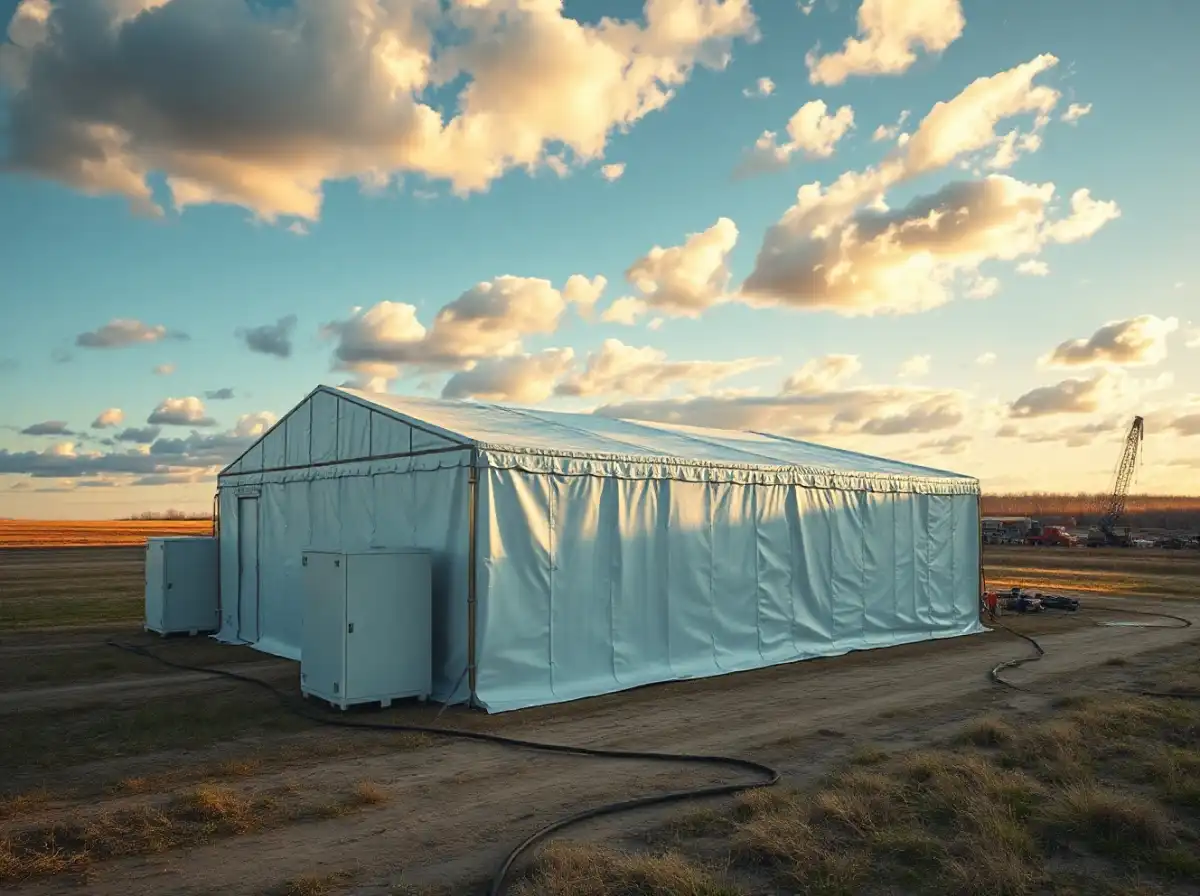
Meta has adopted an unconventional approach to data center construction by building six large tents outside New Albany, Ohio, to house its AI chips. This strategy borrows from Tesla's playbook for accelerating factory output and from xAI's use of off-grid gas turbines for power.
What Happened
According to Michael Thomas, founder of Cleanview, a firm that tracks data center deployments, Meta began building five 125,000-square-foot tents between April and June 2026. Satellite images reviewed by Thomas show the structures are now complete. The approach mirrors Tesla's decision to erect a tent in the parking lot of its Fremont, California factory during the Model 3 production ramp — a move that allowed the automaker to cut construction time dramatically.
The use of tents is reminiscent of those Tesla built in the parking lot of its Fremont, California factory when it was rushing to roll out the Model 3. The site is also powered by 200 megawatts of modular gas turbines nearby, a tactic popularized by competitor xAI. Inside the tents, AI chips, likely worth billions of dollars, will do their work.

Background and Context
Meta CEO Mark Zuckerberg first mentioned the plan to use weatherproof tents for multi-gigawatt data centers in an interview with The Information last year. This approach is part of Meta's efforts to accelerate its AI infrastructure buildout, which has been facing challenges in recent months.
A recent report in The Wall Street Journal found that Meta's latest model, Muse Spark, is complete, but the APIs that developers rely on to access it have been repeatedly delayed. Meta has said it intends to spend up to $145 billion on data centers and other capital expenditures — a figure that has unsettled Wall Street.
Why It Matters
The move comes as Meta faces mounting pressure to deliver its AI models to developers. By using tents, Meta can bring AI compute capacity online in months rather than years, which is crucial for the company's plans to accelerate its AI infrastructure buildout.
The use of off-grid power from modular gas turbines also allows Meta to bypass traditional utility connection delays, which can take years for large-scale data centers. This approach enables Meta to quickly scale up its AI compute capacity and meet the growing demand for AI services.
What Comes Next
Meta's decision to use tents for data center construction is a significant shift in how the company is scaling its AI infrastructure. The move is likely to be closely watched by other tech companies, which may follow suit in adopting similar strategies to accelerate their own AI buildouts.
The success of this approach will depend on various factors, including the cost-effectiveness and scalability of the tents, as well as the company's ability to manage the power supply and cooling requirements for the AI chips inside the tents.
Key Facts
- Meta has built six large tents outside New Albany, Ohio, to house its AI chips.
- The tents are designed to cut construction time in half, mirroring Tesla's approach during the Model 3 production ramp.
- The site is powered by 200 megawatts of modular gas turbines, a tactic popularized by competitor xAI.
- Meta has said it intends to spend up to $145 billion on data centers and other capital expenditures.
- The APIs that developers rely on to access Meta's latest model, Muse Spark, have been repeatedly delayed.
Meta's decision to use tents for data center construction is a significant shift in how the company is scaling its AI infrastructure. The move is likely to be closely watched by other tech companies, which may follow suit in adopting similar strategies to accelerate their own AI buildouts.