
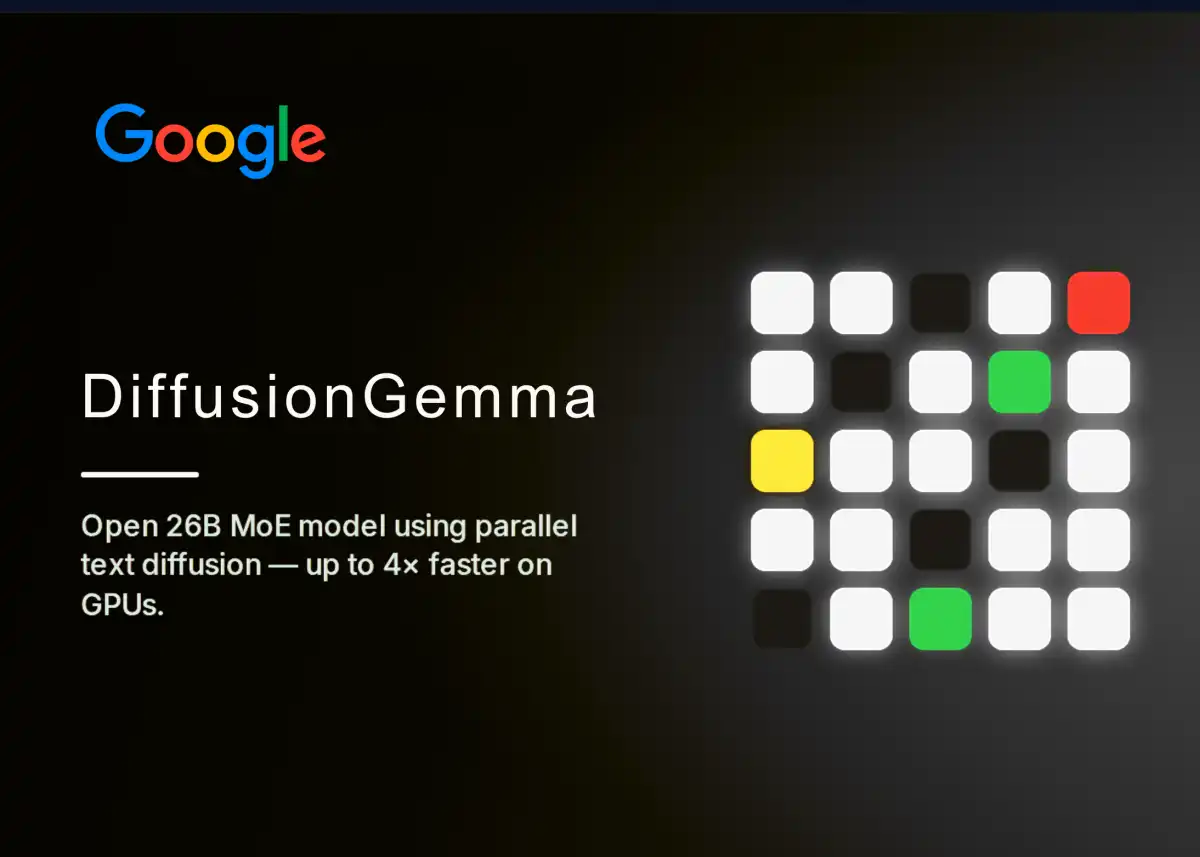
Google's latest AI model, DiffusionGemma, has been released as an open-source experimental model for text generation. This new approach uses a diffusion-based architecture to generate entire blocks of text simultaneously, resulting in up to 4x faster text generation on dedicated GPUs compared to traditional autoregressive models.
DiffusionGemma is built on the Gemma 4 backbone and integrates a novel diffusion head designed to maximize generation speed. This model is particularly beneficial for researchers and developers exploring speed-critical, interactive local workflows such as in-line editing, rapid iteration, and generating non-linear text structures.
Background and Context
Most large language models in use today are autoregressive, generating one token at a time, left to right. Each new token depends on the token before it, creating a speed bottleneck for applications requiring real-time responses. DiffusionGemma takes a different route, inspired by diffusion techniques that power modern image generators.

The model begins with a noisy representation and gradually refines it into coherent text, allowing multiple parts of a response to be processed simultaneously rather than strictly word-by-word. This approach has been shown to significantly improve the speed of text generation without requiring massive increases in computing resources.
Why It Matters to the Industry
The release of DiffusionGemma is significant for several reasons. Firstly, it demonstrates that diffusion-based approaches can become practical for language generation, opening the door to lower latency AI experiences, better scalability, and more efficient hardware utilization.
This could prove especially valuable as AI assistants continue moving from cloud servers to laptops, smartphones, and edge devices. The ability to generate text at speeds of up to 4x faster than traditional models will enable developers to build more interactive and responsive applications, improving user experiences while reducing infrastructure costs.
What Comes Next
DiffusionGemma is currently available under a permissive Apache 2.0 license and can be downloaded from Hugging Face. Google has optimized the model for NVIDIA GeForce RTX GPUs, the NVIDIA RTX PRO platform, and NVIDIA DGX Spark systems, making it accessible to developers and researchers.
The release of DiffusionGemma marks an important step in the development of more efficient and effective AI models. As research continues to advance, we can expect to see even faster and more powerful models emerge, further transforming the way we interact with language-based applications.
Key Facts
- DiffusionGemma is an open-source experimental model for text generation using a diffusion-based architecture.
- The model generates entire blocks of text simultaneously, resulting in up to 4x faster text generation on dedicated GPUs compared to traditional autoregressive models.
- DiffusionGemma is built on the Gemma 4 backbone and integrates a novel diffusion head designed to maximize generation speed.
- The model is particularly beneficial for researchers and developers exploring speed-critical, interactive local workflows such as in-line editing, rapid iteration, and generating non-linear text structures.
- DiffusionGemma is available under a permissive Apache 2.0 license and can be downloaded from Hugging Face.
Technical Specifications
DiffusionGemma is a 26B Mixture of Experts (MoE) model that activates only 3.8B parameters during inference. It has a context window of 256K tokens and supports 140+ languages. The model can be quantized to fit within 18GB of VRAM, making it accessible on high-end consumer GPUs.
On a single NVIDIA H100, DiffusionGemma reaches 1000+ tokens per second, while on an NVIDIA GeForce RTX 5090, it reaches 700+ tokens per second. This makes it an attractive option for developers and researchers looking to build more interactive and responsive applications.