
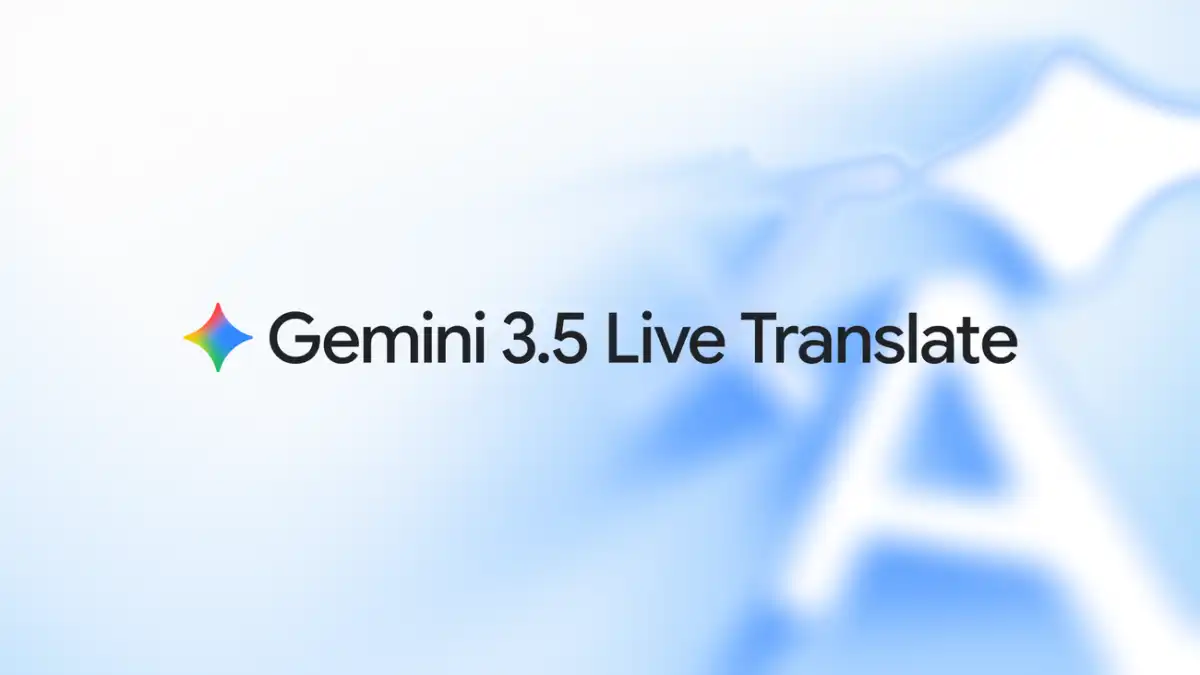
Google has announced the release of Gemini 3.5 Live Translate, a new audio model that enables near-real-time speech-to-speech translation in over 70 languages. This technology is part of Google's ongoing efforts to improve language translation and communication across its products.
What Happened
The new Gemini 3.5 Live Translate model is designed to automatically detect languages and generate smooth, natural-sounding translated speech that preserves the speaker's intonation, pacing, and pitch. Unlike traditional turn-by-turn translation systems, Gemini 3.5 Live Translate continuously generates audio, maintaining a few seconds lag to ensure contextual accuracy while staying in sync with the speaker.
According to Google, this model is a significant advancement in language translation technology, building on two decades of machine learning efforts in this area. The company has been working towards real-time translation for years and has now made it available across several products, including the Google Translate app, Google Meet, and the Gemini Live API.

Background and Context
Google's Gemini 3.5 Live Translate is a result of the company's ongoing research in machine learning and natural language processing. The technology has been developed to address the limitations of traditional translation systems, which often rely on turn-by-turn mechanisms that can disrupt the natural flow of conversation.
The new model uses advanced noise robustness features to maintain pinpoint accuracy even in loud or chaotic environments. This makes it suitable for real-world applications such as live interpretation in meetings, lessons, and broadcasts. Google has also integrated SynthID watermarks into all AI-generated audio to ensure detectability and prevent misinformation.
Why It Matters to the Industry
The release of Gemini 3.5 Live Translate is significant for the adult industry as it addresses several key challenges faced by platforms and operators. One major advantage of this technology is its ability to handle multilingual inputs without manual configuration, which can be a complex and time-consuming process.
Another benefit is the model's robustness to noise, which enables seamless communication even in environments with background noise or other distractions. This can be particularly useful for adult industry platforms that often involve live streaming or video conferencing.
What Comes Next
Google has announced that Gemini 3.5 Live Translate will be available across several products, including the Google Translate app on Android and iOS, as well as in private preview within Google Meet for enterprise users. The company is also providing developers with access to the Gemini Live API and Google AI Studio.
Several companies, including ride-hailing service Grab, are already testing the technology for real-time communication between drivers and riders. Early feedback from partners highlights impressive translation quality, accuracy, and low latency.
Key Facts
- Gemini 3.5 Live Translate is a new audio model that enables near-real-time speech-to-speech translation in over 70 languages.
- The model automatically detects languages and generates smooth, natural-sounding translated speech that preserves the speaker's intonation, pacing, and pitch.
- Gemini 3.5 Live Translate continuously generates audio, maintaining a few seconds lag to ensure contextual accuracy while staying in sync with the speaker.
- The model uses advanced noise robustness features to maintain pinpoint accuracy even in loud or chaotic environments.
- Google has integrated SynthID watermarks into all AI-generated audio to ensure detectability and prevent misinformation.
As the adult industry continues to evolve, technologies like Gemini 3.5 Live Translate will play an increasingly important role in enabling seamless communication across languages and cultures. With its advanced noise robustness features and ability to handle multilingual inputs without manual configuration, this technology has the potential to revolutionize the way platforms and operators interact with their users.