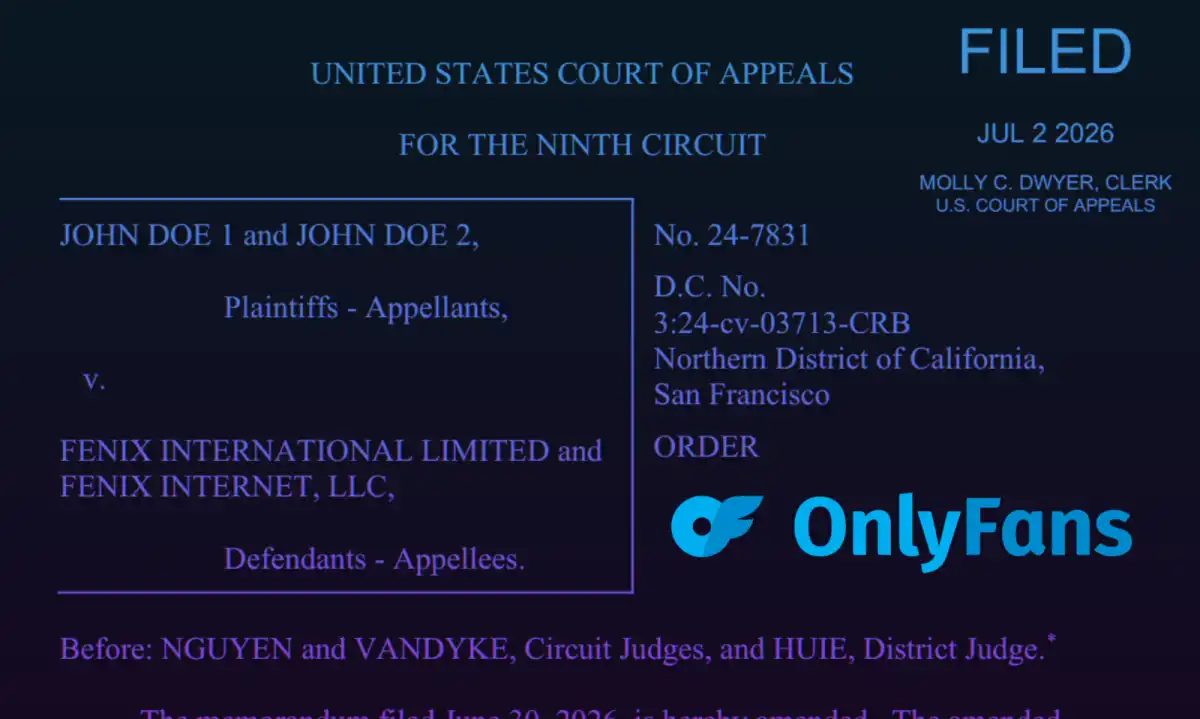
A recent decision by the U.S. Ninth Circuit Court of Appeals has revived a class action lawsuit against Fenix International Limited, the parent company of OnlyFans.com, focusing on the platform's auto-renewing subscription services. The ruling, issued on June 30, reversed a federal district court's dismissal, asserting that the lower court erred in determining it lacked personal jurisdiction over Fenix's operations in California. This development means the case, which centers on alleged violations of California's Automatic Renewal Law (CARL), will return to the district court for further proceedings, potentially impacting how adult content platforms design and implement their subscription management systems.
The core of the legal challenge lies in the technological implementation of subscription billing and user consent mechanisms. The plaintiffs, two consumers identified as John Doe, contend that OnlyFans failed to secure "explicit affirmative consent" for auto-renewing subscriptions and did not provide "clear disclosures" regarding renewal terms and cancellation procedures. For platforms operating on recurring revenue models, particularly those in the adult industry where user privacy and discreet transactions are paramount, the technical implications of such legal requirements are significant. Developers and platform operators must ensure their user interfaces and backend systems are robust enough to handle granular consent, transparent communication, and simplified cancellation pathways, all while maintaining a seamless user experience.
What Does California's Automatic Renewal Law Demand from Platforms?
The California Automatic Renewal Law (CARL), a state unfair competition law, mandates specific compliance interventions for businesses offering subscriptions, free trials, and recurring payments for digital services and products. Enacted to protect consumers from unknowingly entering into auto-renewing agreements, CARL requires platforms to obtain "explicit affirmative consent" from users before enrolling them in such services. This isn't merely a legal formality; it translates directly into engineering and UX/UI design challenges. Platforms must implement clear, unambiguous consent flows during the sign-up or subscription process, ensuring that users actively agree to auto-renewal terms rather than passively opting in through pre-checked boxes or obscure disclosures.

Beyond initial consent, CARL also stipulates that businesses must provide "clear disclosures" about how users can easily cancel digital services. This necessitates intuitive and accessible cancellation pathways within the platform's user interface. For adult content platforms, where user anonymity and ease of managing subscriptions without public scrutiny are often critical, designing a "simple and effective" cancellation experience is crucial. Furthermore, the law requires notification of fee changes and other alterations to user agreements or subscription conditions. This means backend systems must be capable of tracking individual subscription terms, identifying relevant changes, and reliably delivering timely, clear notifications to users, potentially through email, in-app messages, or other communication channels.
The plaintiffs' allegations against Fenix International Limited specifically highlight these technical shortcomings. They claim that OnlyFans did not "formulate a clear user experience to obtain the consumer's affirmative consent to the agreement containing automatic renewal terms." One plaintiff, a California resident, reported being consistently charged $20 per month for an OnlyFans subscription initially listed at $4, further underscoring concerns about transparent pricing and consent. These claims suggest that the current implementation on OnlyFans may not meet the stringent requirements for explicit consent and clear disclosure, posing a challenge for platforms that rely on similar subscription models.
How Does Jurisdiction Impact Global Platform Operations?
A key aspect of the Ninth Circuit's decision revolved around the question of personal jurisdiction. The federal district court, in its April 2025 ruling, had initially dismissed the case, agreeing with Fenix International Limited that, as a company headquartered in London, United Kingdom, it lacked jurisdiction in California. However, the appellate panel disagreed, concluding that the plaintiffs had established that Fenix "expressly aimed its conduct at California." The judges noted that Fenix "regularly fulfills users’ subscriptions wherever those users access its online content, including California," thereby establishing a sufficient nexus for jurisdiction.
This ruling has significant implications for technology companies, particularly those operating global online platforms like OnlyFans, which serve users across various jurisdictions. It underscores the principle that even if a company's physical headquarters are located internationally, its digital operations and revenue generation within a specific state can establish personal jurisdiction. For adult content platforms, which often have a global user base and operate with varying legal frameworks across different regions, this means that compliance with state-specific laws, such as California's CARL, cannot be overlooked simply due to an international corporate structure.
The appellate court's decision effectively means that platforms cannot shield themselves from state-specific consumer protection laws by asserting a foreign domicile if their services are actively consumed and generate revenue within that state. This requires a more sophisticated approach to compliance, where platform operators must consider the legal requirements of every jurisdiction where their services are accessed and subscriptions are processed. This could involve geo-fencing specific features, tailoring user agreements based on location, or implementing region-specific consent flows and cancellation policies. The technical architecture must be flexible enough to adapt to these varying legal landscapes, adding complexity to platform development and maintenance.
What Are the Potential Technical Repercussions for Subscription Models?
If the CARL claims against Fenix International Limited ultimately prevail, it could necessitate a comprehensive overhaul of subscription management frameworks across the OnlyFans ecosystem and potentially impact competitor platforms. The law requires adopting transparent billing and subscription procedures, ensuring users are fully informed to grant express consent, and simplifying user experiences for renewals and cancellations. For platform engineers, this translates into several critical areas of focus.
First, the user onboarding and subscription initiation flows will require meticulous design to ensure "explicit affirmative consent." This might involve multi-step consent processes, clear and prominent disclosures of auto-renewal terms, and active user acknowledgment (e.g., clicking an "I agree to auto-renewal" checkbox rather than a general "subscribe" button). Backend systems must be capable of logging and auditing these consent events to provide an irrefutable record of user agreement. Second, the cancellation process must be "simple and effective." This means avoiding dark patterns or convoluted steps designed to deter cancellation. A single-click cancellation option, clearly visible within the user's account settings, might become a standard requirement. This impacts not only the front-end user interface but also the backend logic that processes cancellations and manages billing cycles.
Furthermore, the requirement to notify users of fee changes and other alterations to user agreements demands robust notification systems. Platforms will need to implement reliable mechanisms for sending timely and clear communications, potentially leveraging email, SMS, or in-app notifications. These systems must also track which users have received and acknowledged these notifications. The potential impact extends beyond the parent company to the "millions of adult content creators who use OnlyFans," as their ability to generate recurring revenue depends on a compliant platform. Developers and operators in the adult industry must view this case as a critical indicator of evolving regulatory expectations for subscription services, pushing for greater transparency and user control in their technical implementations.