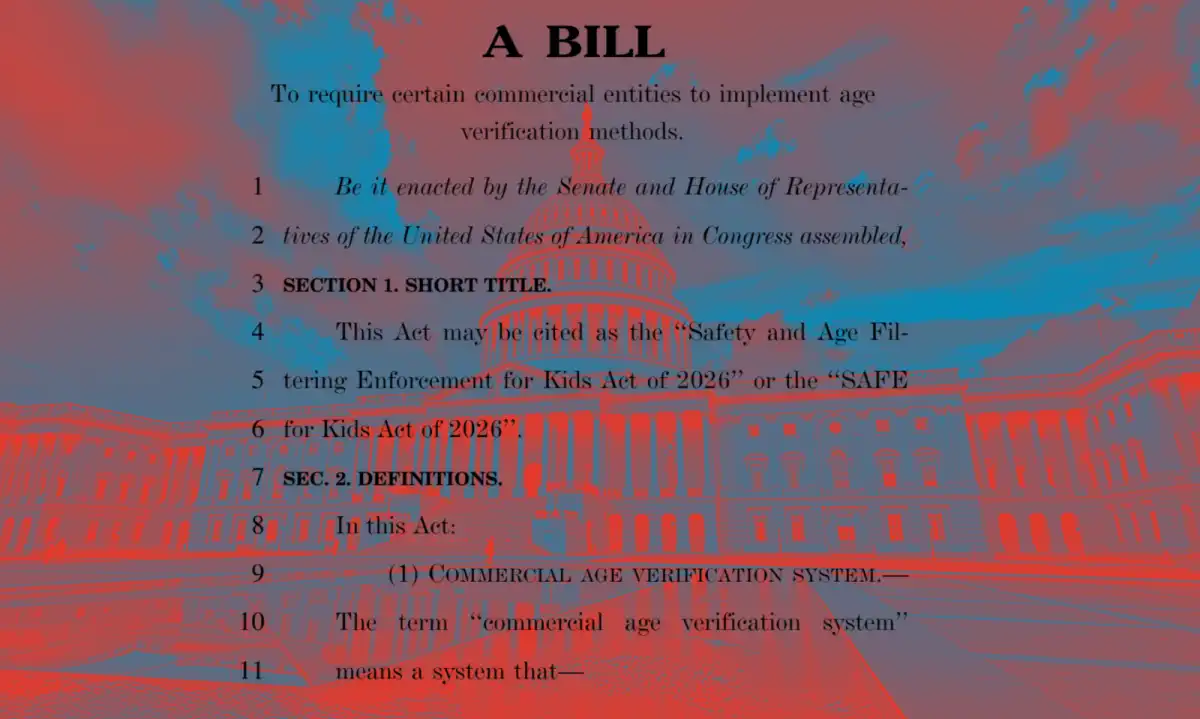

A new federal bill, the Preventing Rampant Online Technological Exploitation and Criminal Trafficking (PROTECT) Act of 2026, introduced by Senator Mike Lee of Utah, proposes to significantly alter the operational landscape for adult content platforms and potentially mainstream social media. The legislation, which mirrors North Carolina's HB 805 enacted in 2025, mandates stringent new requirements for age verification, explicit content consent, and content removal, posing substantial technological and legal compliance challenges for platforms.
The PROTECT Act of 2026 aims to expand nationwide the rigorous requirements previously imposed at the state level in North Carolina. These include verifying performers' ages and consent through processes that extend beyond the federal record-keeping mandates of Section 2257, which requires producers of sexually explicit content to maintain records of performer names and ages, verified by government ID. The proposed federal bill would necessitate explicit written consent for each individual sexual act depicted in content, along with separate, detailed consent for distribution. This distribution consent would need to specify geographic area, medium, and duration. Furthermore, the bill stipulates that producers, performers, and distributors must utilize consent forms either created or approved by the U.S. attorney general. A critical provision allows individuals appearing in adult content to withdraw their consent at any time, a measure that, when implemented in North Carolina via HB 805, raised concerns among industry advocates about the effective invalidation of existing model contracts.
The definition of "covered platforms" under the PROTECT Act is broad, encompassing websites or platforms that "primarily" provide a forum for user-generated content (UGC) or for which providing adult content is "in the regular course of trade or business." This definition could extend the bill's reach beyond traditional adult sites to include mainstream social media platforms. Mike Stabile, Director of Public Policy for the Free Speech Coalition, noted that while the bill is aimed at adult sites, its most significant impact could be on platforms like X, Reddit, Discord, Telegram, and even YouTube, as well as forums like 4chan, if they allow for the distribution of any sexual material, explicit or not. Stabile highlighted that the adult industry already largely complies with age and consent verification, suggesting the new requirements would disproportionately affect non-adult platforms. The bill's definition of "pornographic image" as any visual depiction of sexually explicit conduct, "actual or feigned," further complicates matters, potentially requiring documentation for mainstream films, art, parody content, and documentary films.

What are the Technical and Operational Hurdles for Platforms?
The proposed legislation introduces substantial technical and operational challenges for platforms, particularly those handling large volumes of user-generated content. Implementing systems to verify explicit written consent for "each individual sexual act" and detailed distribution parameters for every piece of content would require a complete overhaul of current content ingestion and metadata management processes. Platforms would need robust database structures capable of linking granular consent data to specific content segments, rather than just entire works. This level of detail would necessitate advanced content analysis tools, potentially leveraging AI, to identify and categorize individual sexual acts within video or image files, a task fraught with technical complexity and potential for error. The requirement for consent forms created or approved by the U.S. attorney general also implies a need for dynamic, legally compliant digital forms and secure, auditable storage for these sensitive documents, accessible for regulatory review.
The provision allowing individuals to withdraw consent at any time presents a significant engineering challenge for content distribution and rights management. Platforms would need to develop real-time content identification and removal mechanisms that can swiftly locate and delist content based on withdrawn consent, potentially across multiple distribution channels and geographic regions. This is particularly complex for platforms that syndicate content or operate on distributed architectures. The 72-hour takedown mandate, as seen in North Carolina's HB 805, requires highly efficient incident response systems and dedicated staff, implying substantial investment in both personnel and automated tools for content moderation and rights management. For platforms hosting user-generated content, verifying the age, identity, and consent of every individual in every uploaded work with "complete certainty," as noted by industry attorney Corey Silverstein, is a theoretical ideal that is far more complex in practice due to the sheer volume and diversity of content.
How Will Age and Consent Verification Evolve?
The PROTECT Act's mandates would necessitate a significant evolution in age and consent verification technologies beyond current industry standards. While Section 2257 focuses on record-keeping for performer age and identity, the new bill demands explicit written consent for each sexual act and detailed distribution parameters. This moves beyond simple age gating or performer identity verification to a granular, content-specific consent model. Platforms would need to integrate sophisticated digital identity verification solutions that can securely link a performer's verified identity to their specific consent for each act and distribution parameter. This could involve blockchain-based consent tracking, advanced biometric verification for digital signatures, or other cryptographic methods to ensure immutability and auditability of consent records.
For user-generated content platforms, the challenge is amplified. Current age verification methods often focus on the viewer, not the content creator or depicted individual. The PROTECT Act would require platforms to verify the age and consent of every person depicted in uploaded content, a task that could necessitate AI-powered facial recognition and age estimation tools, coupled with robust identity document verification for content creators. The legal requirement for attorney general-approved consent forms suggests a need for standardized digital templates that can be integrated into content submission workflows, ensuring legal compliance at the point of creation or upload. The ability to withdraw consent at any time further complicates this, requiring systems that can not only verify initial consent but also manage its revocation and trigger immediate content removal, a complex data management and content delivery network (CDN) challenge.
What are the Potential Legal and Economic Impacts?
The PROTECT Act proposes both civil and criminal penalties for violations, including fines of up to $10,000 per day per image, private lawsuits for damages, and prison sentences ranging from five to ten years for repeat violators. These severe penalties introduce significant legal and economic risks for platforms. The potential for daily fines per image could quickly escalate into crippling liabilities, forcing platforms to invest heavily in compliance infrastructure or risk financial ruin. The threat of criminal charges for platform operators and employees could also deter legitimate businesses from operating in the adult content space or even from hosting content that could be broadly interpreted as "pornographic" under the bill's definitions.
The broad definition of "covered platforms" and "pornographic image" could lead to a "chilling effect," as described by Corey Silverstein. Platforms, particularly mainstream social media sites, might choose to proactively remove or refuse to host lawful content rather than face the severe civil and criminal liabilities associated with potential non-compliance. This could lead to an over-censorship of constitutionally protected speech, impacting a wide range of content from artistic works to documentary films. The experience with FOSTA/SESTA, which aimed to combat sex trafficking but inadvertently reduced lawful online speech, serves as a cautionary tale. Legislators risk imposing obligations that primarily burden legitimate businesses, potentially driving bad actors to offshore or anonymous platforms that operate outside U.S. jurisdiction, thereby undermining the bill's stated objectives while stifling innovation and legitimate expression within the regulated industry.