Rep. Marjorie Taylor Greene has sparked controversy over her stance on artificial intelligence (AI) policy, specifically regarding a provision in President Donald Trump's One Big Beautiful Bill (OBBB) that would prevent states from regulating AI for 10 years.
What Happened
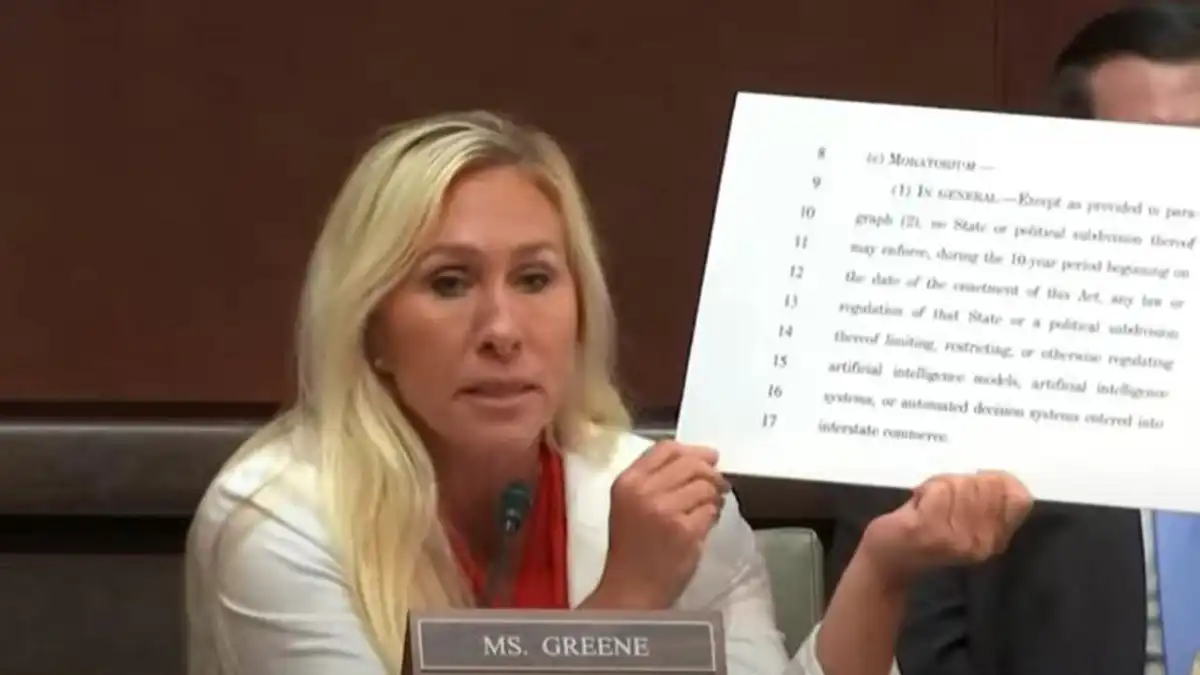
Greene initially voted in favor of the OBBB, but later expressed her opposition to the AI provision after discovering it on pages 278-279 of the bill. She claimed she was unaware of the section when she cast her vote and argued that it would "strip states of the right to make laws or regulate AI for 10 years," which she deemed a "violation of state rights." Greene urged the Senate to strip the provision, stating that giving AI free rein could have "potentially dangerous" consequences.
Greene's reversal on the OBBB has sparked criticism from Democrats and other lawmakers. Rep. Ted Lieu (D-CA) accused her of not reading the bill before voting on it, while Rep. Mark Pocan (D-WI) took aim at Greene for missing the provision, stating that she "owned" the vote.

Background and Context
The OBBB is a sweeping 1,000-page bill that includes various provisions related to tax and domestic policy. The AI provision in question prohibits states from enforcing any law or regulation limiting, restricting, or otherwise regulating artificial intelligence models, systems, or automated decision-making tools for a 10-year period.
Greene's opposition to the OBBB's AI provision is not her first public disagreement with Trump on AI policy. In July 2025, she expressed "deep concerns" over Trump's AI Executive Order, which aimed to promote the rapid buildout of data centers across the country by expediting and modernizing permits for data centers and semiconductor fabs.
Greene argued that rushing AI expansion could have "massive future implications and problems," citing concerns about environmental and critical water supply impact. She also claimed that data centers are like "black holes when it comes to water requirements," consuming massive amounts of water for cooling, which could lead to competition among counties for water resources.
Why It Matters to the Industry
The controversy surrounding Greene's stance on AI policy has significant implications for the adult industry. The use of AI in content moderation and age verification is becoming increasingly prevalent, with many platforms relying on automated systems to manage user-generated content.
The OBBB's AI provision could potentially limit states' ability to regulate these technologies, which raises concerns about data protection, privacy, and the potential for AI-driven content moderation to infringe on free speech rights. The industry must carefully monitor developments in AI policy to ensure that regulations do not inadvertently harm or restrict its operations.
What Comes Next
The fate of the OBBB's AI provision remains uncertain as it heads back to the Senate for further consideration. Greene has vowed to oppose the measure if it returns unchanged, while other lawmakers have expressed concerns about the potential consequences of limiting states' ability to regulate AI.
As the debate over AI policy continues, the adult industry must remain vigilant and adapt to changing regulatory landscapes. The use of AI in content moderation and age verification is likely to become more widespread, and platforms must ensure that they are equipped to handle these technologies while maintaining compliance with evolving regulations.
Key Facts
- The OBBB includes a provision that prohibits states from regulating AI for 10 years.
- Rep. Marjorie Taylor Greene initially voted in favor of the OBBB but later expressed opposition to the AI provision.
- Greene argued that giving AI free rein could have "potentially dangerous" consequences and urged the Senate to strip the provision.
- The OBBB's AI provision has raised alarms from Democrats, other lawmakers, and state lawmakers who have written a letter opposing the measure.
- Greene's stance on AI policy is not her first public disagreement with Trump, having expressed "deep concerns" over his AI Executive Order in July 2025.