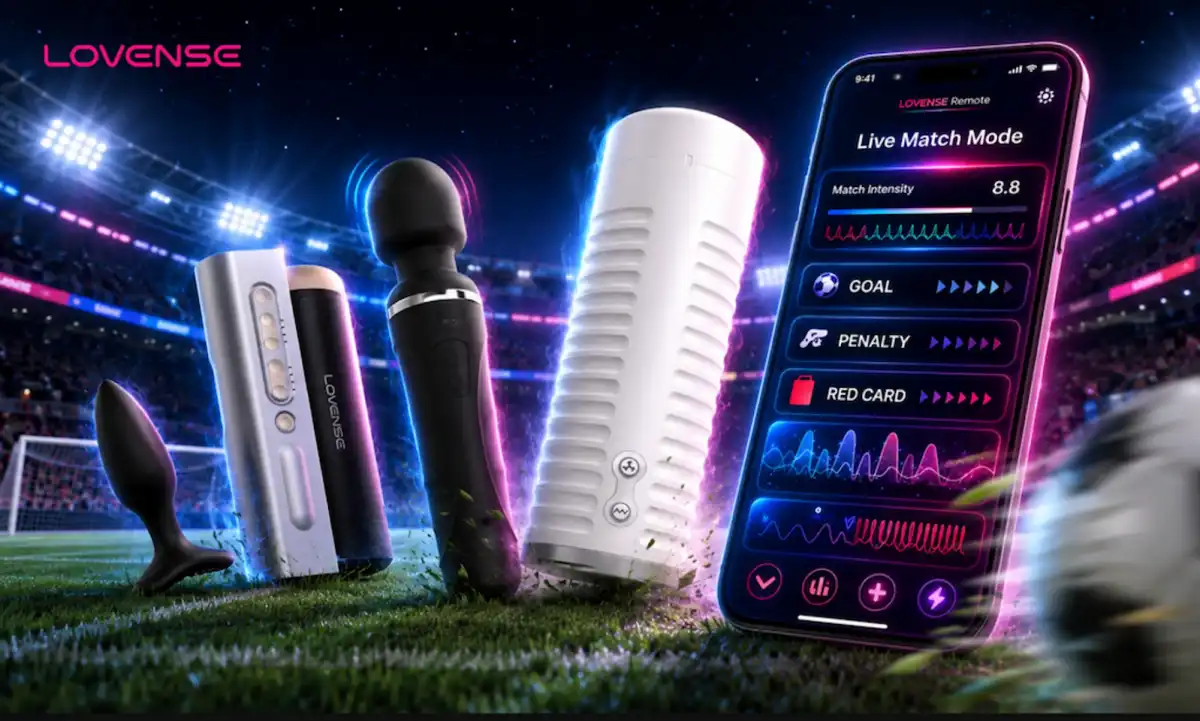
Lovense, a sex-tech brand, has launched Match Intensity, a new interactive experience designed to synchronize live World Cup match events with connected intimacy devices in real time. This development, available within the Lovense Remote App from June 28 to July 19, 2026, during the tournament's knockout stage, represents an advancement in real-time sensory feedback integration for connected devices, offering adult industry developers and platform operators a case study in leveraging live event data streams for interactive user experiences.
The Match Intensity feature translates key moments from football matches, such as goals, scored penalties, and red cards, into responsive sensory feedback. This real-time data processing and device control demonstrate a technical approach to creating immersive, synchronous experiences. For platforms dealing with live streaming, interactive content, or connected hardware, the ability to parse external event data and translate it into immediate, tangible user feedback presents opportunities for enhanced engagement and novel product offerings. The challenge lies in ensuring low-latency data transmission, reliable event detection, and precise device synchronization across potentially diverse user environments and network conditions.
How Does Real-Time Event Synchronization Work?
Match Intensity operates on a dual-layer vibration system, combining continuous background intensity with event-triggered surges. The background layer dynamically adjusts vibration strength in real time, responding to the pace and overall intensity of the match. This requires a continuous data feed that can interpret the ebb and flow of a live event, likely involving algorithms that analyze game metrics or commentary for overall activity levels. Maintaining a consistent, responsive background experience without overwhelming the user or draining device power efficiently is a key engineering consideration for developers building similar systems.

The event layer adds specific vibration patterns, designed by Lovense, for critical moments such as goals, scored penalties, and red cards. These patterns deliver stronger, more dramatic sensations when the action reaches its peak. Implementing this layer necessitates robust event detection mechanisms that can reliably identify specific, high-impact occurrences within a live broadcast or data stream. The precision and speed with which these events are detected and translated into device commands are crucial for maintaining the illusion of real-time synchronization. Any significant delay between the on-screen event and the physical feedback could disrupt the user's immersive experience.
Integrating External Data Streams for Enhanced User Interaction
The integration of live match data into the Lovense ecosystem highlights the potential for adult industry platforms to leverage external data streams for interactive content. This approach moves beyond pre-programmed or user-initiated interactions, instead drawing on globally recognized, real-time events. For developers, this means exploring APIs or data feeds that provide timely and accurate information about external events, whether they are sports, financial markets, or other public occurrences. The technical infrastructure must be capable of ingesting, processing, and acting upon this data at scale, potentially for hundreds of millions of simultaneous users across various time zones and network conditions.
Beyond direct event synchronization, the Lovense ecosystem also incorporates a Sound Mode, where device vibrations can respond to the volume of live commentary, crowd noise, or the energy of a watch party. This feature demonstrates the use of ambient audio analysis as another input for real-time sensory feedback. For platforms, this could involve on-device audio processing or server-side analysis of audio streams, translating sound characteristics into control signals for connected devices. Such capabilities require robust audio processing algorithms and careful consideration of privacy implications, especially if audio is processed off-device.
Challenges in Scalability and Latency for Global Interactive Experiences
The global nature of events like the World Cup, with hundreds of millions of fans experiencing moments simultaneously across diverse geographies and time zones, presents significant challenges for real-time interactive systems. Ensuring that "football's most electrifying moments are being felt across countries, time zones, and cultures" in the "very same second" demands a highly distributed and low-latency architecture. Developers must contend with network latency, server load, and the varying capabilities of user devices to deliver a consistent and synchronized experience worldwide.
The technical infrastructure supporting Match Intensity must manage the real-time processing of event data, the generation of appropriate vibration patterns, and the reliable transmission of these commands to individual user devices. This involves considerations for edge computing, content delivery networks (CDNs), and efficient communication protocols to minimize delays. For adult industry platforms, where real-time interaction and responsiveness are often critical for user engagement, the lessons learned from such global synchronization efforts can inform the design of more robust and immersive interactive experiences, from live cam shows with haptic feedback to synchronized group experiences.